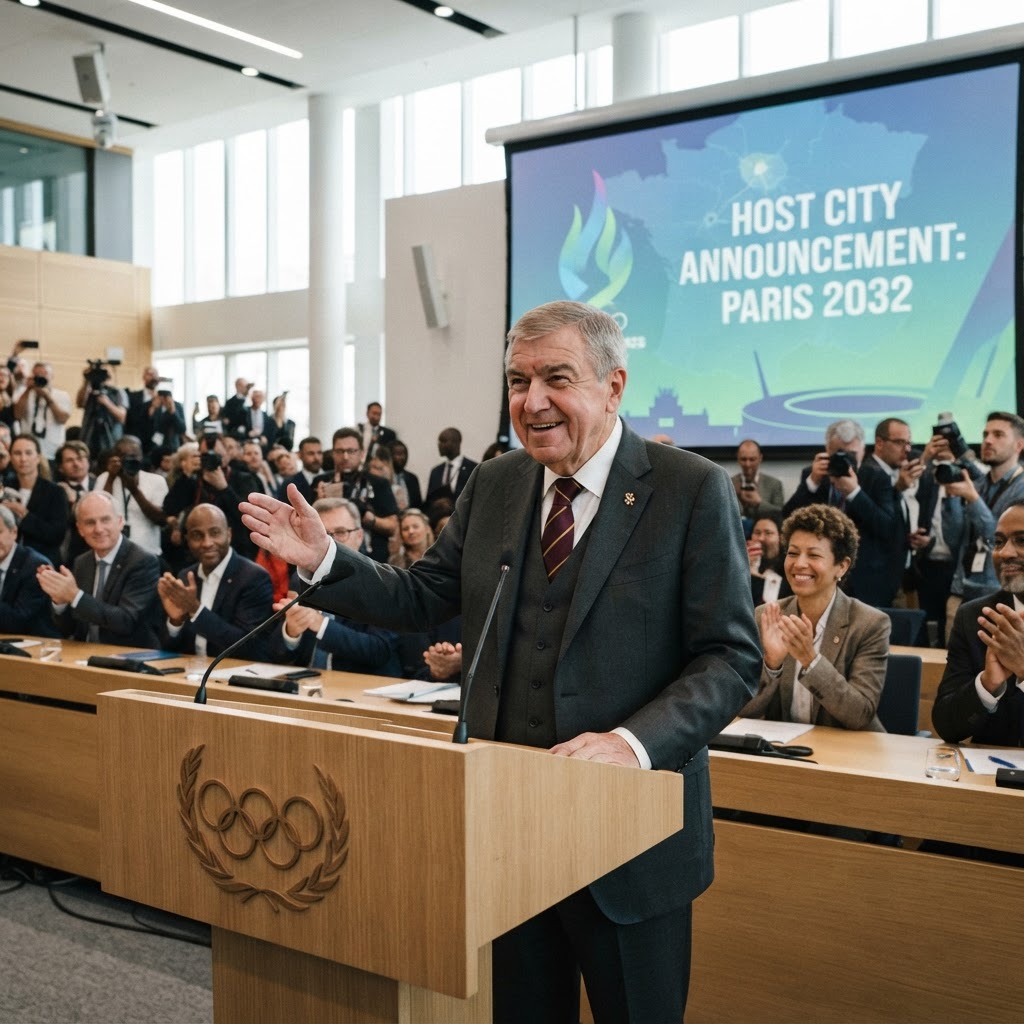
In an announcement that reverberated across the international sporting community, the International Olympic Committee (IOC) convened in an extraordinary session to officially unveil the host city for the upcoming Olympic and Paralympic Games. The selection represents not only the culmination of a rigorous, multi-year evaluation process but also marks a pivotal strategic juncture for the modern Olympic Movement. As global interest in mega-sporting spectacles intersects with mounting demands for economic prudence, environmental stewardship, and post-pandemic urban resilience, the IOC’s decision is designed to establish an operational and cultural benchmark for decades to come.
The Long-Awaited Decision: Deliberations and Selection
The formal designation was revealed following secret ballot proceedings conducted by the IOC membership, concluding a protracted selection cycle that saw prominent global metropolises submit detailed technical dossiers, environmental impact assessments, and financial guarantees. Unlike historical bid cycles defined by extravagant infrastructure promises and escalating regional rivalry, the recent process operated under the framework of the Olympic Agenda 2020+5 reforms. This strategic framework actively discourages white-elephant projects, emphasizing instead the integration of existing venues, temporary installations, and long-term community value.
Addressing delegates, international sporting federations, and assembled media, the IOC leadership emphasized that the chosen host demonstrated an unmatched alignment with the committee's modernized operational philosophy. The evaluation commission highlighted the city's pre-existing transportation networks, proven capability to host elite international athletic competitions, and deep-seated civic passion for sport as decisive elements in their evaluation scorecards.
Advertisement

"Today’s decision reflects an unshakeable commitment to a new era of the Olympic Games—one where sustainability is not an afterthought, but the bedrock of every decision made. The selected city brings not only world-class athletic facilities, but a coherent vision for sustainable urban renewal that will inspire youth across the globe for generations."
Economic Implications: Shifting Away from White Elephants
Hosting the Olympic Games has historically represented a high-stakes fiscal gamble for municipal and national governments. The phenomenon often cited by sports economists as the 'winner's curse'—where costs far exceed preliminary projections while promised revenues fail to materialize—has led numerous candidate cities to withdraw bids in recent decades. The newly selected host city, however, has pledged an operational model that diverges sharply from historical excess.
Economists analyzing the host city's financial plan note a significant reliance on private-sector capital and pre-existing public transit infrastructure. Instead of allocating tens of billions of dollars to construct monumental, single-use stadiums, the localized strategy relies on retrofitting historical venues and erecting demountable structures that can be repurposed or liquidated following the Paralympic closing ceremony.
- Operational Self-Sufficiency: Projections indicate the organizing committee's operating budget will be largely financed through domestic sponsorship, broadcasting rights, and global ticketing, mitigating reliance on public tax revenue.
- Capital Investment Safeguards: Infrastructure developments are largely tied to municipal master plans that were already greenlit prior to the bid, ensuring that transit expansions directly benefit local taxpayers.
- Long-Term Tourism and Trade: Strategic trade partnerships and projected influxes of international visitors are expected to provide sustained growth across the hospitality, logistics, and service sectors.
Independent analysts urge cautious optimism. While the structural blueprint appears fiscally resilient on paper, inflationary pressures, supply chain volatility, and specialized security requirements historically pose significant budget risks during the final triennium of pre-Games preparation.
Urban Renewal, Sustainability, and Environmental Metrics
Central to the host city's winning proposal was an uncompromising focus on environmental responsibility and climate neutrality. As global sports organizations face increasing scrutiny regarding their carbon footprints, the organizing committee has pledged to deliver a climate-positive event that leaves a measurable, positive ecological legacy in the metropolitan region.
The urban regeneration master plan focuses on revitalizing post-industrial riverfront districts and underdeveloped urban corridors. By situating the primary athletes' village in an area identified for social housing needs, the municipal government plans to transition the residential units into affordable housing, complete with net-zero energy standards, green roofs, and community parklands following the conclusion of the Paralympic Games.
Furthermore, the transport strategy guarantees that one hundred percent of ticketed spectators will be able to reach competition venues via electrified public transport or dedicated non-motorized mobility networks. This design not only lowers event-day greenhouse gas emissions but leaves the city with modernized, low-carbon public transit infrastructure that serves everyday citizens long after the Olympic flame is extinguished.
Perspectives from Global Stakeholders: Athletes, Federations, and Civic Society
The announcement has sparked widespread reaction across the international sports ecosystem, eliciting feedback from elite athletes, national Olympic committees, international federations, and civic activist groups.
Athletes' commissions have largely lauded the choice, highlighting the host city’s compact geographic footprint. In past editions, long commutes between distant competition clusters and the Olympic Village imposed physical stress and disrupted preparation routines. The newly confirmed plan prioritizes minimized transit times, centralized medical facilities, and climate-controlled training environments tailored to peak human performance.
International sports federations have similarly endorsed the technical capabilities of the chosen venues, many of which already possess certifications for world championship play across athletics, aquatics, cycling, and team sports. This institutional familiarity significantly lowers operational risk and logistical complexity for competing teams.
Concurrently, local civic groups and community representatives have maintained an active dialogue regarding potential displacement, gentrification, and the fair distribution of civic investments. Municipal leaders have responded by establishing permanent citizen oversight committees, mandated to monitor public spending, labor standards for venue construction, and housing equity metrics throughout the preparation cycle.
Broader Geopolitical and Cultural Significance
The Olympic Games possess a unique cultural gravity, often functioning as an international stage for cultural diplomacy, national branding, and geopolitical maneuvering. For the newly crowned host city, the assignment represents an invaluable opportunity to project its modern identity, cultural diversity, and technological innovation to a global audience exceeding several billion television and digital viewers.
Historically, host selections have served as watershed moments for national emergence or democratic realignment. In the contemporary context, this edition offers a platform to showcase a balanced model of globalization—one that celebrates cultural specificity while reinforcing shared global ideals of international fraternity, peace, and mutual respect amid a deeply fragmented geopolitical landscape.
Cultural programming will play an indispensable role in the lead-up to the opening ceremony. The host committee announced plans for a multi-year Cultural Olympiad, an arts and education festival designed to engage local schools, regional artists, and international creative figures. This program seeks to weave the artistic heritage of the host nation into the fabric of the global competition.
The Road Ahead: Timelines, Milestones, and Potential Obstacles
With the host city formally designated, attention turns toward the complex implementation phase. The transition from bid committee to local organizing committee requires sweeping administrative restructuring, the enactment of national enabling legislation, and the formalization of international broadcast and marketing pacts.
The immediate timeline includes several crucial operational milestones:
- Formation of the Organizing Committee: Formal establishment of governance bodies, including executive appointments and independent ethics and audit panels.
- Master Schedule and Venue Finalization: Submission of the final sports program, venue schedule, and day-by-day competition logistics to the IOC Executive Board.
- Commercial Rollout: Launch of national tiered sponsorship programs, licensing initiatives, and official brand identity reveals, including the emblem and mascot designs.
- Operational Test Events: A rigorous two-year schedule of full-scale test competitions across all competition venues to identify and resolve security, technology, and facility stress points.