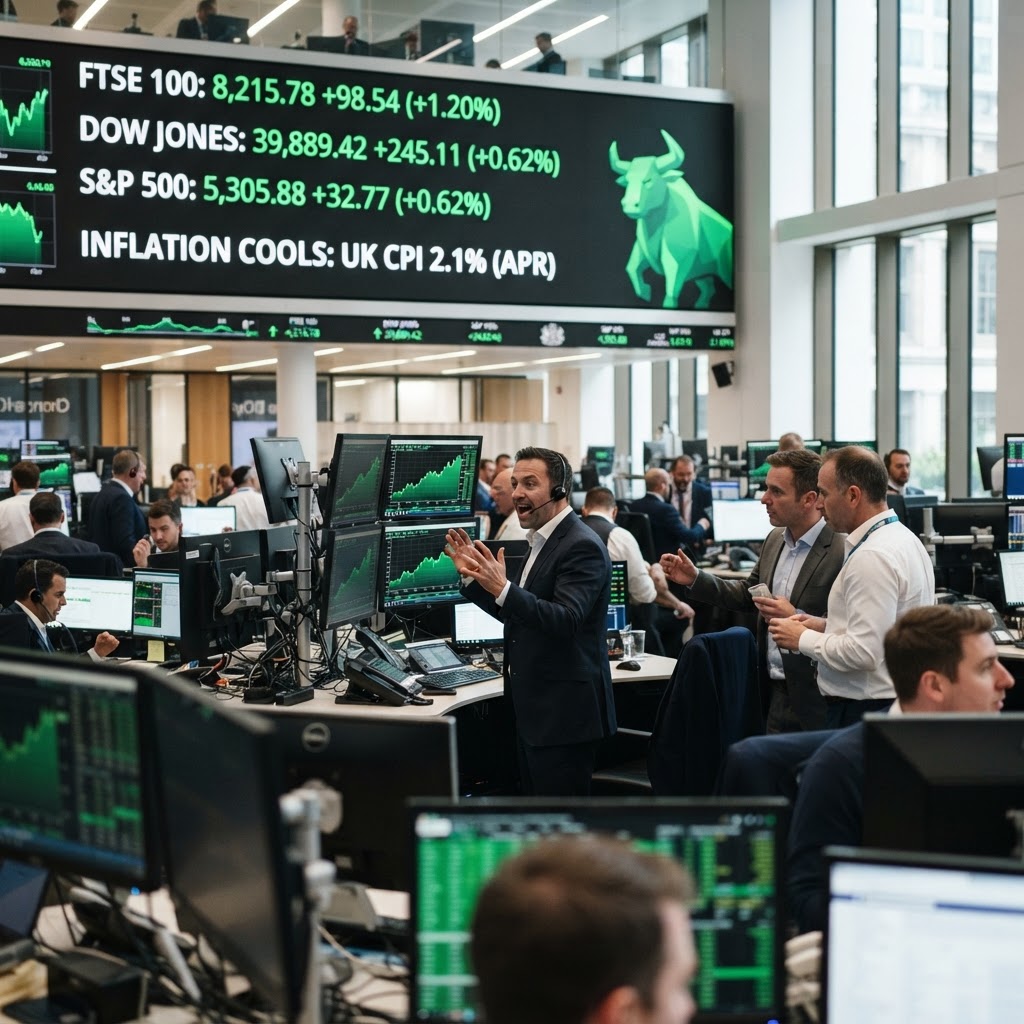
Global financial markets experienced an aggressive surge on Wednesday after government data revealed that headline consumer inflation has dropped to its lowest level in more than two years. The consumer price index rose at an annualized rate that significantly undercut economists' expectations, reinforcing investor confidence that the prolonged cycle of aggressive monetary tightening orchestrated by central banks worldwide is finally yielding tangible results.
The headline Consumer Price Index registered a modest year-over-year increase, marking a dramatic deceleration from the multi-decade highs recorded during the peak of post-pandemic supply disruptions and geopolitical shocks. On Wall Street, the benchmark S&P 500 leaped sharply at the opening bell, led by interest-rate-sensitive megacap technology firms and consumer discretionary stocks. Across the Atlantic, European bourses posted robust gains, while government bond yields retreated sharply as fixed-income traders rapidly priced out further interest rate hikes for the remainder of the calendar year.
A closer look at the underlying data indicates that the cooling trend was predominantly driven by sustained declines in energy prices, wholesale used vehicle markets, and airfare. Gasoline futures tumbled throughout the preceding quarter, providing direct relief at the pump for consumers while substantially lowering freight and distribution costs for intermediate businesses. Furthermore, the persistent downtrend in global shipping freight rates has worked its way through the supply chain, diminishing core goods inflation to a fraction of its prior volatility.
Advertisement

Crucially, the report demonstrated early signs of moderation in the services sector, particularly in housing and shelter costs. Because shelter represents roughly one-third of the headline CPI basket, economists have long awaited a deceleration in market rents to filter into official metrics. Although shelter inflation remains elevated relative to historical averages due to reporting lags, the deceleration in new commercial and residential lease rates observed over the past two quarters is finally manifesting in the primary government aggregates.
Market analysts and portfolio managers have framed the data as a pivotal turning point for risk assets. Equities have been battered over the preceding eighteen months under the weight of the Federal Reserve’s most rapid monetary tightening regime since the early 1980s. With benchmark interest rates hovering at levels not seen since before the 2008 global financial crisis, the specter of an overtightening-induced recession has weighed heavily on corporate earnings forecasts and enterprise valuation multiples.
The swift drop in inflation has altered that risk equation. A prominent consensus is forming across financial institutions that central banks may achieve the elusive "soft landing"—a macroeconomic scenario where inflation recedes to the statutory two percent target without triggering a broad-based contraction in labor markets or a deep economic downturn. Corporate balance sheets, while strained by elevated debt service expenses, have demonstrated remarkable structural resilience, aided by strong consumer balance sheets and robust labor retention policies.
In the fixed-income sphere, the response was immediate. The yield on the benchmark 10-year Treasury note dropped substantially, reflecting an easing of longer-term inflation expectations. Simultaneously, the two-year Treasury yield, which closely mirrors market sentiment regarding short-term policy decisions, experienced its steepest single-day decline in months. Currency markets also absorbed significant realignments, as the U.S. Dollar Index slipped against a basket of major trading partners, providing breathing room for emerging market economies burdened with dollar-denominated external debt obligations.
Despite the prevailing optimism across trading floors, policymakers remain cautious. Representatives from the Federal Reserve and international central banking institutions have maintained a measured public posture, cautioning against premature celebrations. Central bank officials emphasize that "core" inflation—which deliberately strips out volatile components such as food and energy—remains above long-term mandates. The structural tightness of the domestic labor market, characterized by elevated wage growth and low unemployment rates, continues to present an upside risk to non-housing service prices.
Economists have noted that while the headline metrics reflect considerable progress, the final leg of the disinflationary process is often the most difficult. Structural shortages in select specialized labor pools, elevated wage settlements negotiated by major labor unions, and persistent geopolitical tensions in commodity-producing regions could create intermittent inflationary pressures. Consequently, monetary authorities are expected to signal a prolonged period of high interest rates rather than immediate or aggressive policy rate cuts, reinforcing the "higher for longer" policy doctrine.
Sector-by-sector, the market reaction offered clear insight into changing macroeconomic sentiment. Growth stocks, whose high valuations are disproportionately sensitive to discount rates derived from long-term yields, surged forcefully. Cloud infrastructure providers, semiconductor designers, and enterprise software companies outpaced the broader market averages. Conversely, defensive sectors such as consumer staples, utilities, and healthcare underperformed on a relative basis, as portfolio managers aggressively rotated capital out of safe-haven assets and back into cyclical and growth-oriented instruments.
Small-capitalization firms, measured by standard regional indices, experienced an even more dramatic relief rally. Smaller enterprises, which typically rely on variable-rate credit facilities and lack the deep balance-sheet liquidity of their large-cap counterparts, have borne the brunt of commercial credit contractions following recent banking sector stresses. The prospect of an impending interest rate plateau offers vital stabilization for regional commercial borrowers, mitigating credit default probabilities across regional banking ecosystems.
For household consumers, the decelerating rate of price growth represents a much-needed psychological and practical reprieve. While price levels themselves remain substantially higher than they were prior to the inflationary surge, the pace of real wage deterioration has effectively stalled. Real disposable personal income has stabilized, allowing middle-income households to preserve purchasing power despite compounding credit card borrowing costs and diminished pandemic-era savings reserves.
Looking ahead, financial market participants will scrutinize upcoming labor releases and the upcoming Producer Price Index for confirmation that wholesale margins are normalizing at a sustainable cadence. Corporate earnings season will also serve as a crucial reality check, forcing executive leadership teams to reconcile forward guidance against shifting consumer demand patterns. The central question dominating executive suites has pivoted from how to pass along operational cost increases to how to preserve unit volumes in an environment where pricing power is rapidly eroding.
The broader macroeconomic outlook remains complex, balanced between falling inflation figures and the residual drag of cumulative monetary policy tightening. Yet...