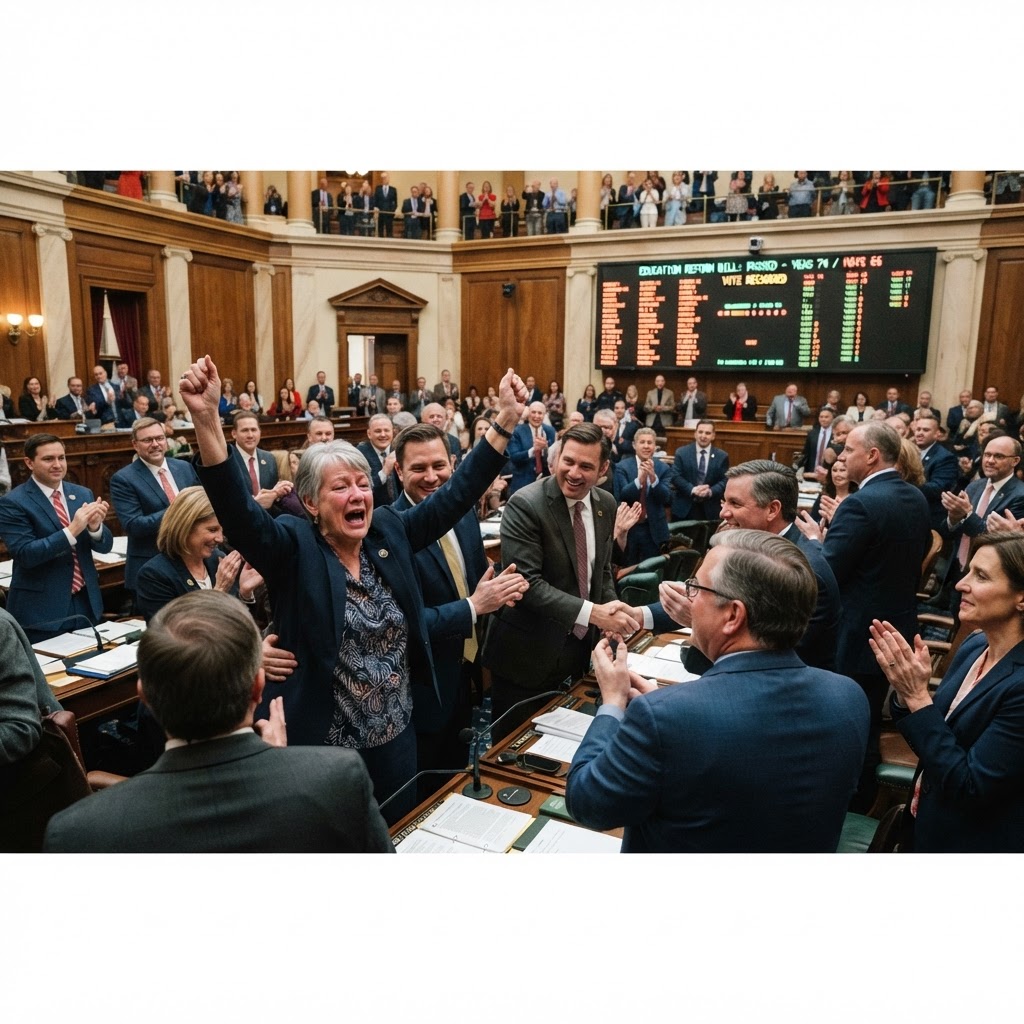
Following months of acrimonious floor debates, closed-door committee negotiations, and sustained pressure from advocacy groups across the political spectrum, lawmakers have officially passed landmark education reform legislation. The sweeping measure, which represents the most significant overhaul of the public education framework in over a decade, cleared the legislative chamber late Tuesday evening in a decisive yet hard-fought vote. The final tally marks the culmination of an arduous legislative process that exposed deep ideological divides over state versus local governance, pedagogical standards, and the equitable distribution of public funds.
The comprehensive bill addresses critical pressure points within the contemporary school ecosystem, establishing sweeping updates to K-12 funding formulas, teacher compensation frameworks, accountability metrics, and early childhood education access. For months, the legislation appeared perpetually stalled, trapped in a contentious tug-of-war between competing legislative factions. Proponents framed the bill as an indispensable modernization effort designed to address systemic inequalities exacerbated by post-pandemic learning loss, while critics warned of fiscal overreach, bureaucratic bloat, and the potential erosion of community-level decision-making.
At the structural core of the approved legislation is a fundamental recalibration of how foundational funding is calculated and distributed to school districts. Historically reliant on localized property tax bases—a model long criticized for cementing socioeconomic disparities between affluent suburbs and distressed inner-city or rural districts—the new statutory formula introduces an equity-weighted distribution model. Under this architecture, state appropriations will prioritize districts serving disproportionately high concentrations of low-income students, English language learners, and children requiring specialized instructional accommodations. State budget analysts project that this transition will redirect billions in supplemental funding to historically under-resourced districts over the next five fiscal cycles.
Advertisement

The legislation also mounts a direct response to the national teacher recruitment and retention crisis. School districts nationwide have reported catastrophic vacancies in core subject areas, with educators leaving the profession in unprecedented numbers due to stagnating wages, administrative burdens, and escalating political polarization surrounding classroom curricula. The newly approved statute mandates a competitive baseline minimum salary for certified public school educators, coupled with targeted student loan forgiveness initiatives for teachers who commit to working in historically high-need rural or urban schools for a minimum duration of five years.
Securing the passage of these provisions required extensive, eleventh-hour compromises that significantly reshaped the bill’s final text. Earlier iterations contained polarizing voucher mechanisms that would have allowed public tax dollars to subsidize private and parochial school tuition. That proposal galvanized intense pushback from public education coalitions, civil rights organizations, and teacher unions, who argued that redirecting state funds to non-public institutions would gut public school infrastructure. In the compromise brokered during marathon weekend sessions, expansive voucher mechanisms were largely excised and replaced with targeted tax-credit scholarship initiatives subject to stringent income caps and state auditing standards.
Accountability and student performance assessments formed another contentious front throughout the protracted negotiations. The enacted compromise de-emphasizes punitive high-stakes standardized testing in favor of a hybrid growth-model assessment. Under the previous regime, low standardized test scores could trigger state intervention, accreditation reviews, or district restructuring. The new framework instead evaluates schools based on longitudinal student progress, chronic absenteeism remediation, graduation rates, and workforce readiness metrics alongside standardized evaluations. Advocates assert this multifaceted rubric provides a more holistic, humanizing reflection of student development and school climate.
Reactions to the bill’s passage have been swift and varied across the educational and policy landscape. National and regional educators' unions have cautiously embraced the outcome, characterizing the wage enhancements and resource infusions as a critical victory for frontline workers. Union representatives, however, were quick to note that funding mandates must be strictly guarded against future legislative rescissions or executive budget cuts. Several union leaders issued statements emphasizing that while the bill offers vital structural scaffolding, the genuine test of its efficacy will rest entirely upon the execution and administrative clarity provided during the rollout phase.
Conversely, regional school boards and municipal administrators have voiced measured concern regarding the aggressive compliance timetables stipulated in the legislation. Administrative bodies will be tasked with revising localized curricula, updating staffing matrices, and implementing new student reporting mechanisms within an accelerated eighteen-month window. District superintendents have raised alarms regarding whether state educational agencies will possess the operational capacity to provide guidance, regulatory clarifications, and technical support fast enough to avert compliance chaos at the district level.
Civil rights advocates and equity researchers have largely praised the legislation's targeted allocations, pointing toward provisions designed to dismantle the school-to-prison pipeline. The bill places strict statutory guardrails on out-of-school suspensions and expulsions for non-violent behavioral infractions in primary grades, codifying restorative justice practices into the state education code. Proponents argue these procedural updates will directly mitigate disproportionate disciplinary actions historically leveled against minority students and students with learning disabilities.
Opposition to the final statutory package, while insufficient to block its passage, remains vocal. Conservative policy centers and fiscal watchdogs continue to question the long-term sustainability of the bill’s multi-billion-dollar price tag, warning that any future economic contraction could leave state coffers strained and force municipalities to hike local revenues to fulfill state-directed mandates. Other critics voiced disappointment that the legislation did not go far enough in advancing comprehensive parental-choice initiatives or enacting explicit statutory limits on how complex social, cultural, and historical issues are integrated into humanities curricula.
The bill also sets aside dedicated capital investments for physical school safety and digital connectivity infrastructure. In an era where digital fluency and secure learning environments are non-negotiable prerequisites for academic success, the legislation establishes grant programs for high-speed broadband expansion across isolated rural districts, alongside non-punitive physical facility upgrades focused on mental health support centers and counselor-to-student ratio reductions.
Implementation of the expansive reform package will begin in phased intervals, with an independent oversight committee scheduled to be seated within the next ninety days to monitor regulatory development and financial distributions. Legal observers anticipate potential procedural challenges in the coming months, particularly concerning state-level administrative guidelines and the precise parameters governing the tax-credit scholarship framework. Nevertheless, the successful navigation of this sprawling legislation through an intensely divided legislature represents a...