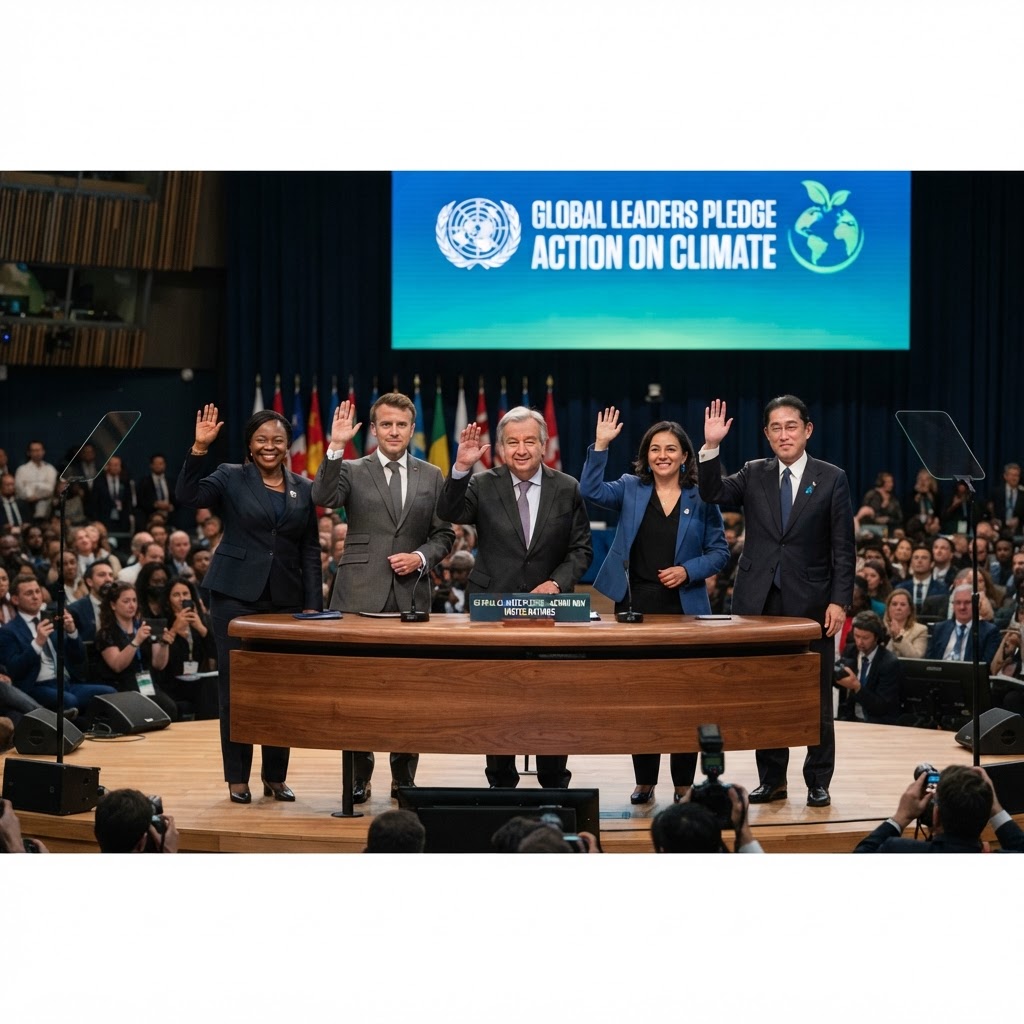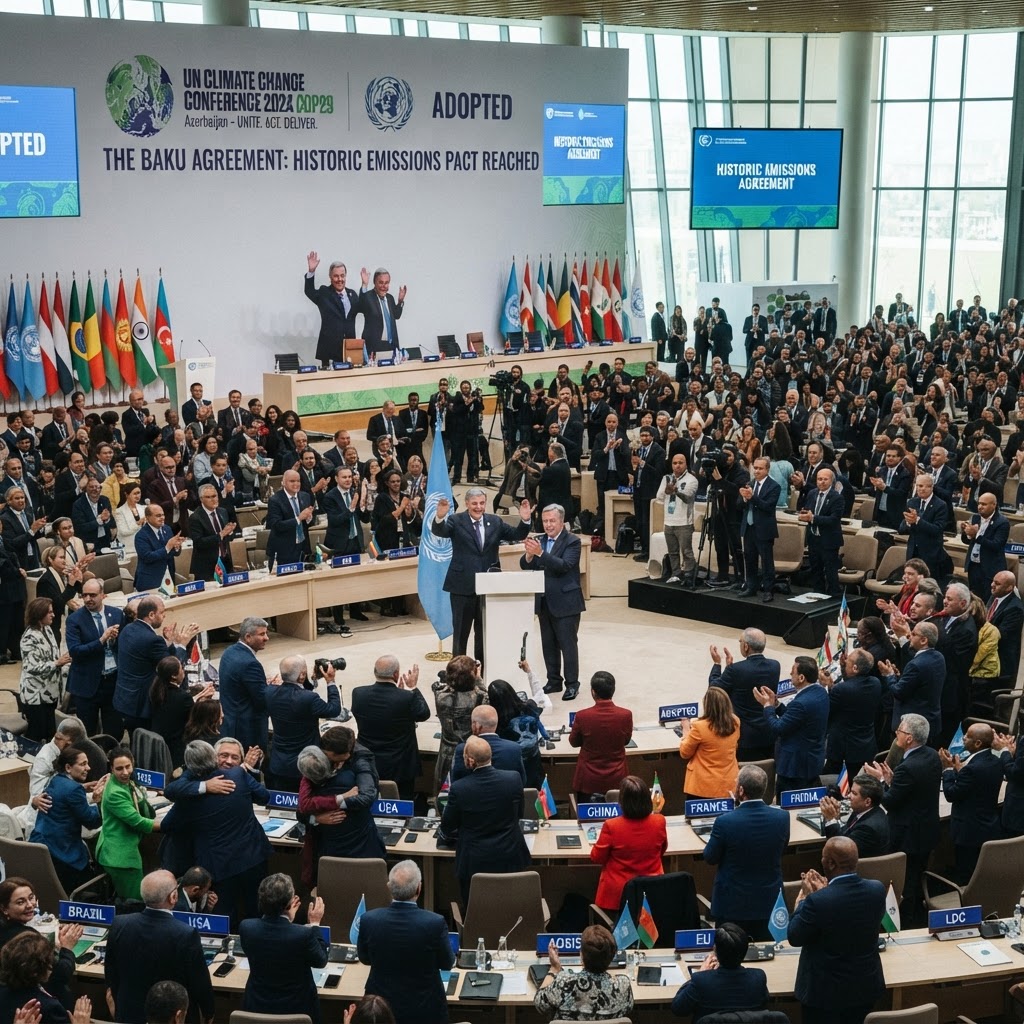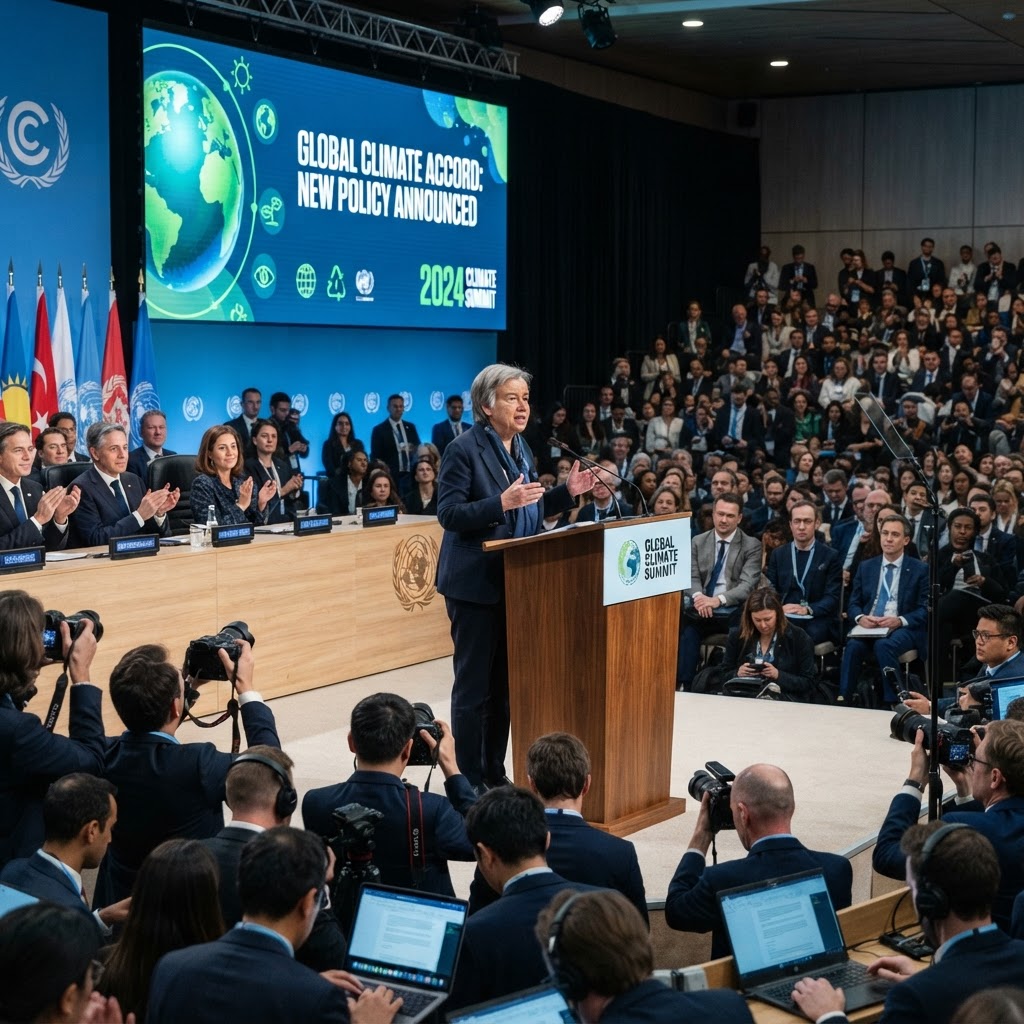
In what delegates are already characterizing as a defining inflection point for international environmental governance, world leaders concluded the annual Global Climate Action Summit by unveiling a comprehensive, legally binding framework aimed at aggressively accelerating decarbonization timelines across the industrialized world. The newly ratified accord, negotiated through marathon overnight sessions marked by intense geopolitical friction, introduces stringent emissions ceilings, establishes standardized mechanisms for carbon border adjustments, and mobilizes unprecedented financial capital directed toward emerging markets vulnerable to climate-induced disruptions.
The policy announcement represents a substantial departure from the voluntary, non-binding pledges that have largely characterized international environmental protocols over the past decade. Central to the agreement is a mandated 55 percent reduction in absolute greenhouse gas emissions by 2035 relative to 1990 baselines, a target that significantly raises the ambition of previous multilateral compacts. Crucially, the framework establishes an independent scientific oversight panel empowered to audit national emissions inventories and levy compliance tariffs on signatory states that consistently fail to meet interim benchmarks.
Negotiations nearly collapsed in the summit's final forty-eight hours over the architecture of the proposed climate finance mechanisms. A coalition of developing nations, spearheaded by island states and sub-Saharan African economies, maintained that aggressive transition mandates could not be imposed without commensurate financial and technological transfers from historic emitters. The compromise reached in the plenary hall establishes a sovereign-backed capitalization facility intended to disburse $300 billion annually starting in 2026, combining direct public sector grants, multilateral development bank guarantees, and private institutional investments.
Advertisement

Industrial decarbonization forms the core operational vector of the newly adopted policy. Under the framework, signatory governments must phase out public subsidies for unabated fossil fuel extraction by 2028, while simultaneously harmonizing regulatory standards for clean hydrogen, carbon capture and storage (CCS), and grid-scale energy storage. The agreement also sets a coordinated sunset date for the internal combustion engine in the personal vehicle sector by 2038, accompanied by standardized incentives designed to secure critical mineral supply chains without triggering localized ecological degradation.
Market reactions across global financial centers were immediate and pronounced. Benchmark European carbon permits surged following the announcement, reflecting expectations of tighter supply in emissions allowances, while clean technology equities saw broad gains across European and North American exchanges. Conversely, traditional integrated oil and gas producers faced valuation pressure as institutional investors began repricing long-term capital expenditure models to account for accelerated terminal decline curves and prospective carbon liabilities.
Independent policy analysts and environmental economists have weighed in on the operational implications of the pact, emphasizing that while the political consensus is historic, the true test lies in domestic legislative ratification. Structural economic realignments of this magnitude inevitably face domestic political headwinds, particularly in jurisdictions where energy affordability and industrial competitiveness remain highly sensitive issues among the electorate. The synchronization of national regulatory regimes across disparate economic blocs remains a massive administrative and diplomatic challenge.
Energy security specialists have noted that the aggressive transition schedule requires unprecedented capital mobilization into electrical transmission infrastructure. Modernizing national grids to integrate highly distributed, intermittent renewable generation while accommodating the exponential load growth driven by the electrification of transport, home heating, and high-density computing centers will require capital expenditures estimated in the trillions of dollars over the next twenty years. Without immediate regulatory reform to expedite infrastructure permitting, the targets set forth in the agreement could outpace physical deployment capacity.
The summit also delivered major breakthroughs in corporate transparency, establishing universal disclosure requirements modeled on the International Sustainability Standards Board (ISSB) recommendations. Multinationals operating within signatory jurisdictions will soon be mandated to disclose audited Scope 1, Scope 2, and material Scope 3 emissions in their statutory annual filings. This standardized reporting protocol aims to eliminate greenwashing and provide institutional asset managers with the empirical data required to systematically reallocate capital toward lower-carbon business models.
Agricultural and land-use provisions represent another significant, if contentious, pillar of the accord. The policy mandates an immediate halt to primary forest clearance for industrial agriculture by 2027, backed by satellite-verified monitoring networks. Agricultural subsidies in high-income nations will be progressively decoupled from volume production and redirected toward regenerative soil management, methane abatement in livestock systems, and wetland restoration. Developing nations containing vast equatorial rainforest reserves have been guaranteed direct ecological service payments linked to forest canopy preservation metrics.
Despite the prevailing optimism among summit leadership, significant skepticism remains within civil society and academic circles. Climate scientists analyzing the text have pointed out that even under ideal implementation scenarios, the projected atmospheric concentrations of carbon dioxide will leave the global climate system dangerously close to critical tipping points. Several prominent non-governmental organizations staged demonstrations outside the plenary hall, criticizing the agreement for leaving open technical loopholes regarding the definition of carbon abatement and the timeline for phasing out metallurgical coal.
The geopolitical ramifications of the policy will be tested almost immediately as governments prepare to submit their updated Nationally Determined Contributions (NDCs) ahead of the next round of treaty reviews. The integration of carbon border adjustments presents a distinct risk of trade disputes at the World Trade Organization, as non-signatory nations or economies with less stringent environmental regulations may challenge what they perceive to be protectionist trade barriers disguised as climate policy.
Ultimately, the comprehensive policy framework announced at the summit serves as a structural blueprint for the rewiring of the modern global economy. By transitioning from aspirational diplomacy to rigid regulatory, financial, and trade mechanisms, the international community has acknowledged that incrementalism is no longer a viable strategy for mitigating catastrophic systemic risk. Whether this sweeping diplomatic achievement successfully translates into tangible reductions in atmospheric carbon depends on the political durability of the commitments made, the execution speed of domestic agencies, and the sustained mobilization of cross-border capital in the decade ahead.