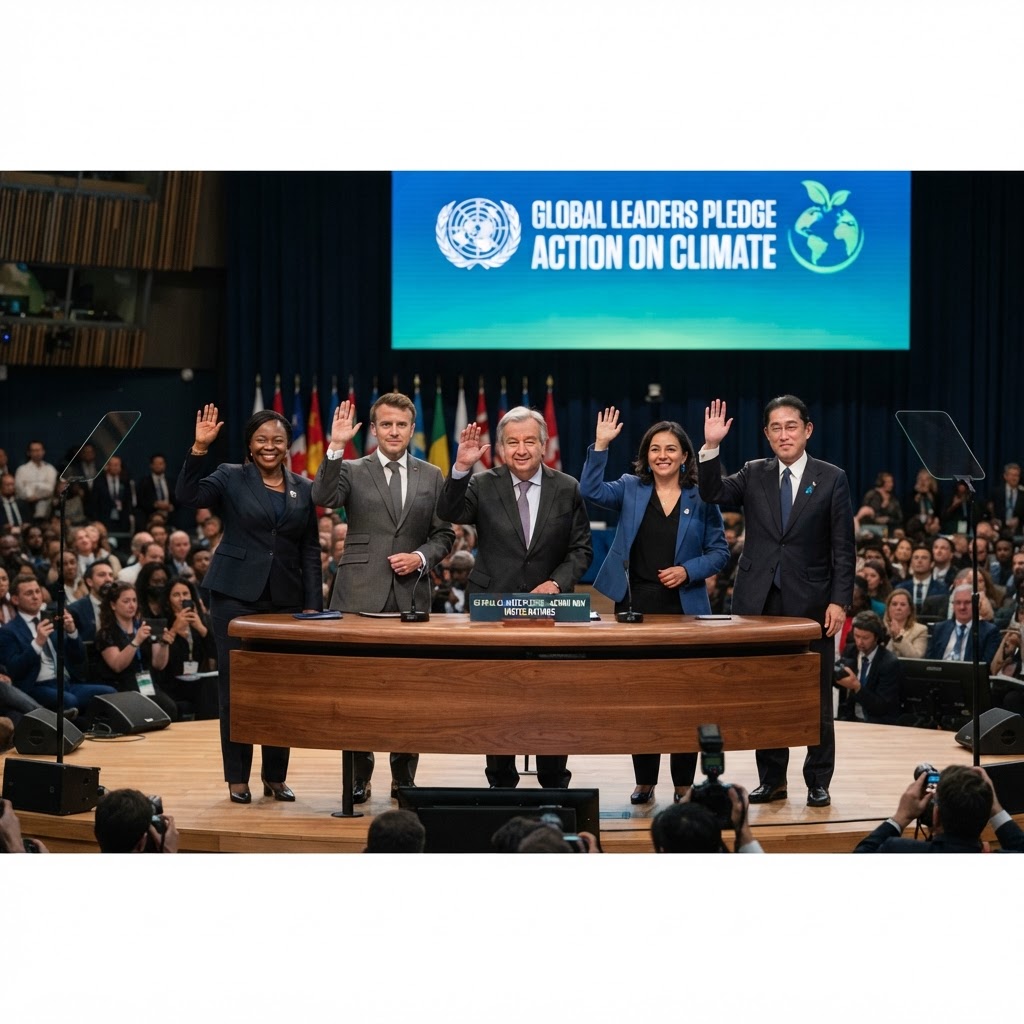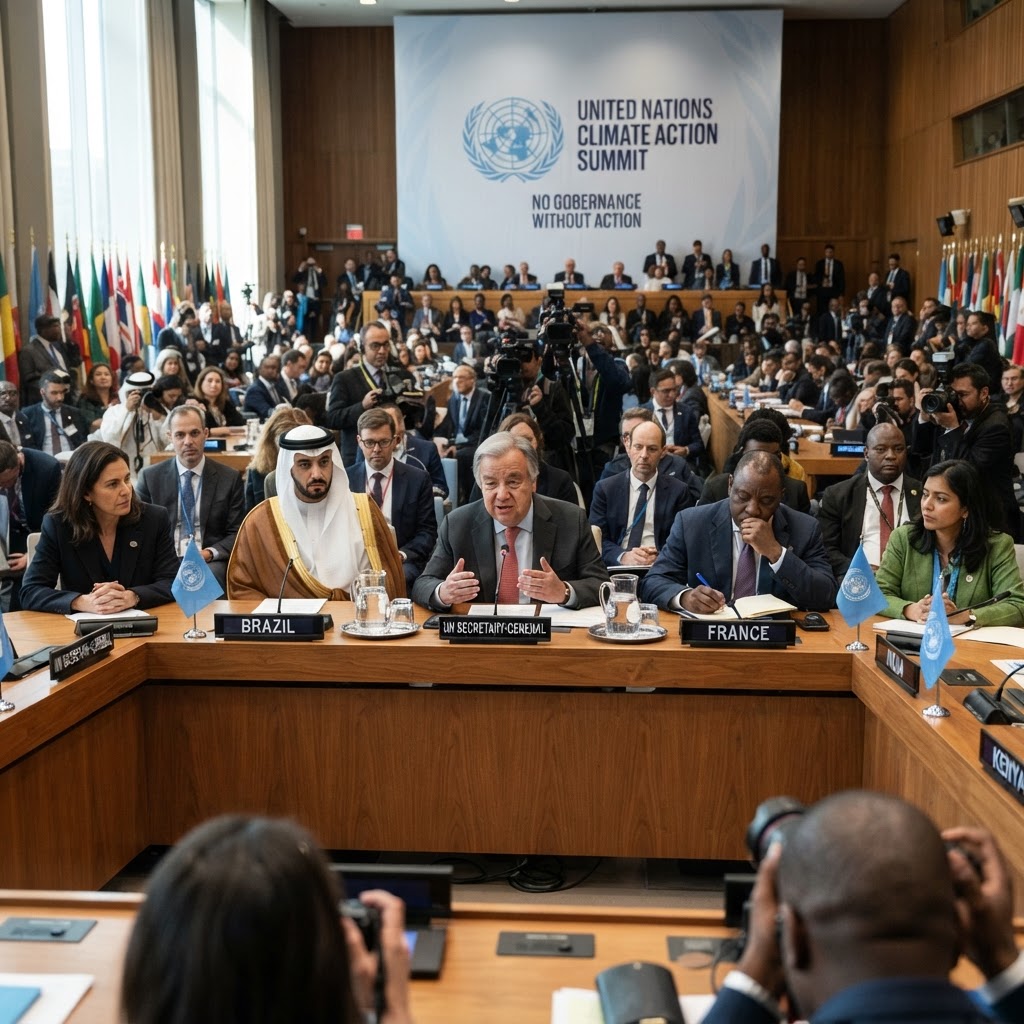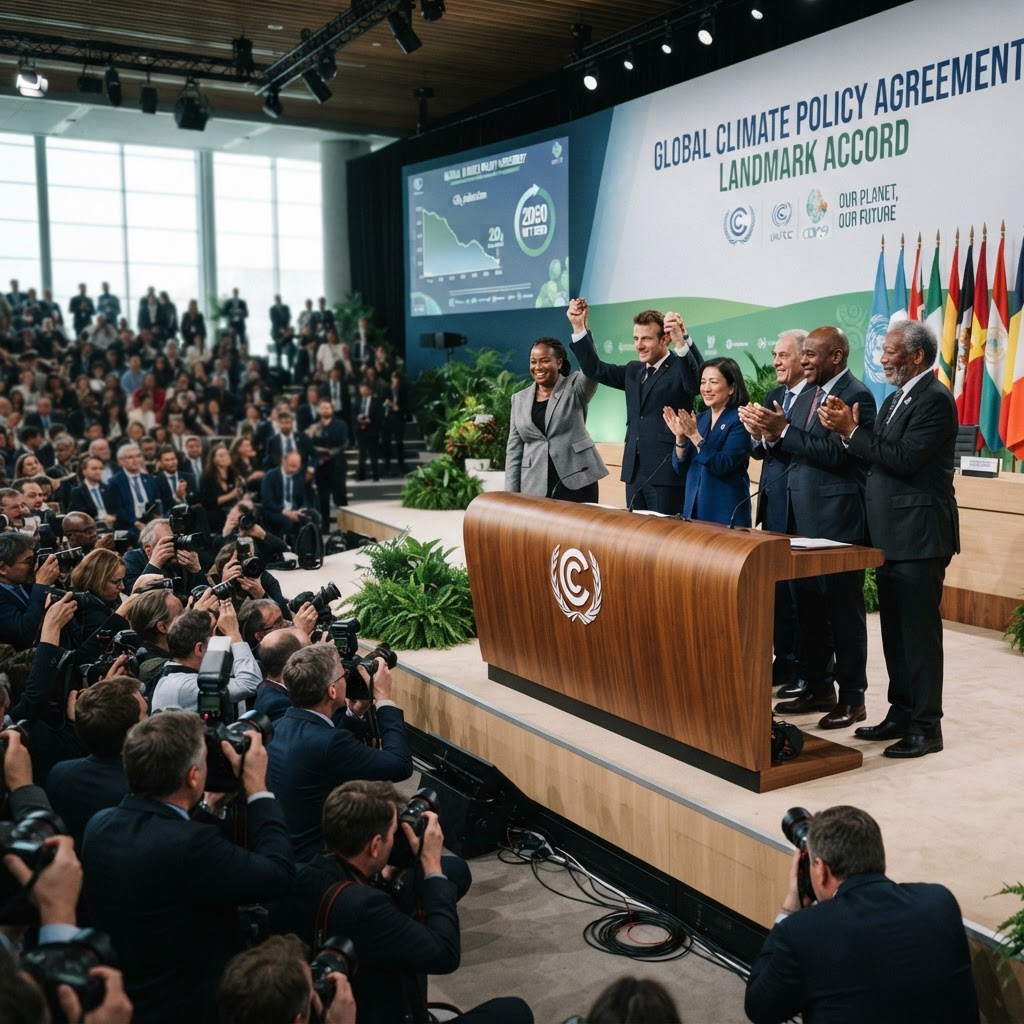
In what delegates are calling the most significant breakthrough in multilateral environmental diplomacy in nearly a decade, world leaders gathered at the Global Climate Summit have announced a landmark policy agreement aimed at reducing carbon emissions by 50% by 2035. The ambitious pact, signed by 45 nations spanning six continents, sets an aggressive new benchmark for the international community as climate scientists warn that the window to avert catastrophic planetary warming is rapidly closing.
The accord, finalized after an intense fortnight of round-the-clock negotiations, establishes legally binding domestic targets for signatories alongside sweeping sectoral overhauls. Central to the framework are commitments to transition rapidly to renewable energy infrastructures and completely phase out unabated coal power plants. Negotiators emerged from the final plenary session in the early hours of the morning, visibly exhausted but triumphant, signaling that the global transition away from fossil fuels has officially accelerated from rhetoric into actionable policy.
Under the terms of the treaty, the 45 signatory nations—which collectively account for roughly 62% of historical greenhouse gas emissions—must submit revised nationally determined contributions within the next eighteen months. These plans must delineate precise pathways for how each country will halve its net carbon output relative to 2010 baseline levels by the 2035 deadline. Independent monitoring bodies, operating under international scientific oversight, will be empowered to audit emissions reductions on a biennial basis, closing a critical accountability loophole that had weakened previous voluntary frameworks.
Advertisement

The mandate to phase out coal-fired power generation represents the most contentious element successfully integrated into the treaty. Coal remains the single largest contributor to global temperature rise, yet it continues to serve as the bedrock of baseload electricity in several major industrialized and emerging economies. The newly minted pact establishes a differentiated timeline: advanced economies have pledged to decommission all unabated coal facilities by 2030, while developing signatories have secured an extended glide path extending to 2038, provided their emissions peak before the end of the current decade.
To balance these aggressive regulatory demands, the policy framework incorporates extensive provisions for climate finance, addressing decades-long grievances raised by the Global South. Recognizing that developing nations often lack the fiscal bandwidth to underwrite capital-intensive green transitions while simultaneously weathering increasingly frequent extreme weather events, the agreement establishes a dedicated multi-billion-dollar green transition fund. Wealthier signatories have committed direct public capital alongside loan guarantees designed to mobilize private investment toward grid modernization, solar, wind, and next-generation storage technologies.
Summit organizers emphasized that equity remained at the heart of the financial mechanisms. For years, climate conferences have been stymied by a fundamental geopolitical friction: developing nations argued that it was unjust to hold them to stringent emissions constraints without substantial capital transfers from the developed economies whose industrialization drove historical atmospheric carbon accumulation. By explicitly tying mitigation mandates to predictable, grants-based financial flows, this agreement has managed to bridge a diplomatic divide that had threatened to derail international climate cooperation entirely.
Financial analysts project that the treaty will catalyze a monumental reallocation of global capital. Energy economists attending the summit estimated that meeting the 2035 targets will require an estimated $3.5 trillion in annual clean energy investments worldwide. The clear policy signal sent by 45 sovereign states is expected to dramatically lower sovereign risk premiums for renewable infrastructure projects, incentivizing sovereign wealth funds, commercial banks, and institutional investors to pivot aggressively away from carbon-intensive asset classes.
Reaction from the global industrial sector has been split, reflecting the sweeping economic disruption the treaty entails. Representatives of the renewable energy and clean technology sectors lauded the policy as an unprecedented market catalyst, predicting exponential job growth in battery manufacturing, green hydrogen production, and decentralized electrical architecture. Conversely, traditional heavy industries, petrochemical enterprises, and mining conglomerates issued cautious statements, urging policymakers to ensure reliable grid baseloads and protect domestic supply chains during the transition.
Environmental advocacy groups and climate scientists offered qualified praise, characterizing the agreement as a vital step forward while underscoring that execution remains the ultimate metric of success. Several scientific observers noted that while a 50% emissions cut by 2035 mathematically aligns with models designed to cap global warming at 1.5 degrees Celsius above pre-industrial levels, the target allows virtually no margin for operational delay or political backsliding. The true test, civil society leaders warned, will arrive when national legislatures are forced to translate these international commitments into domestic statutory law.
The geopolitical ramifications of the agreement are equally profound. Notably absent from the list of initial signatories were several major emerging economies and significant petroleum-exporting states, whose reluctance highlights the persistent friction between immediate fossil fuel revenues and long-term ecological sustainability. Nevertheless, trade policy experts note that the 45-nation bloc holds sufficient economic leverage to impose carbon border adjustment mechanisms, effectively penalizing non-signatory imports and compelling non-participating nations to harmonize their domestic environmental standards or risk severe trade disadvantages.
Domestic implementation will undoubtedly face formidable headwinds within individual signatory nations. In several constitutional democracies, the treaty’s stringent mandates are expected to encounter fierce resistance from regional political leaders, labor unions tethered to fossil extraction industries, and conservative legislative blocs wary of market intervention. Anticipating these domestic hurdles, the summit’s framework includes specific guidelines for a "just transition," mandating that public funds be allocated to retrain displacement-vulnerable energy workers and revitalize local economies heavily dependent on coal mining and thermal power operations.
Technological feasibility also remains a cornerstone of the summit’s broader debate. While utility-scale solar and onshore wind power have achieved cost parity with, or undercut, fossil generation in most major markets, questions remain regarding grid resilience, long-duration battery storage, and the supply chains required for critical minerals such as lithium, cobalt, and rare earth elements. Signatories agreed to establish a cooperative multilateral framework to secure ethical, sustainable supply chains for these critical materials, mitigating the risk of nationalistic trade barriers slowing the deployment of clean technologies.
As the final delegations prepare to depart, the consensus among diplomatic observers is that the summit has altered the political landscape of global climate action. By coupling ambitious...