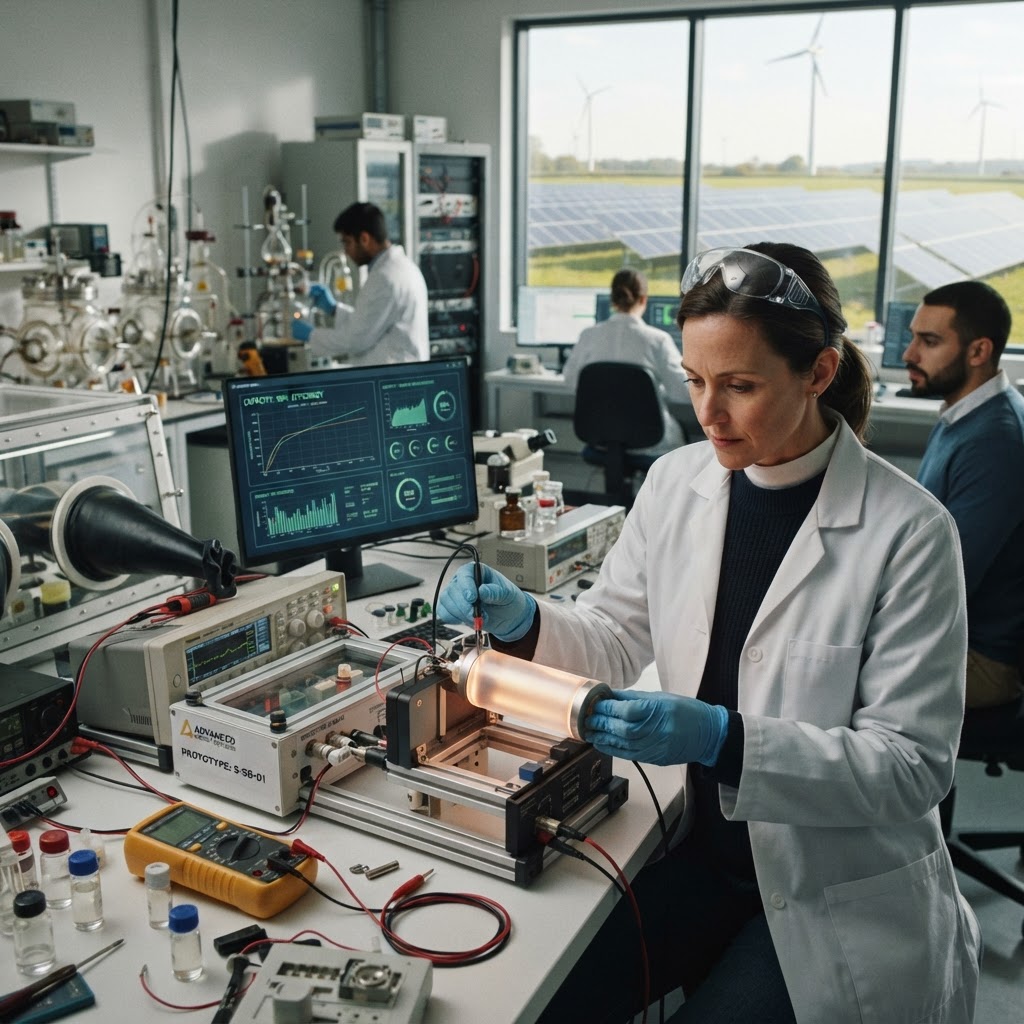
In what is being hailed as a transformative milestone for the global clean energy transition, an international consortium of materials scientists and chemical engineers has unveiled a novel battery architecture capable of storing renewable power with unprecedented efficiency. The breakthrough directly confronts the persistent Achilles' heel of wind and solar generation: intermittency. By drastically reducing storage degradation, cutting manufacturing costs, and employing earth-abundant materials, the newly developed system promises to accelerate the retirement of fossil-fueled peaker plants and stabilize power grids worldwide.
For decades, the transition toward a fully decarbonized energy sector has been constrained not by the ability to generate clean electrons, but by the difficulty of storing them for when the sun sets or winds die down. Traditional lithium-ion batteries, while revolutionary for portable electronics and electric vehicles, carry significant drawbacks when scaled to grid-level infrastructure. High material costs, supply chain vulnerabilities tied to lithium, cobalt, and nickel, thermal runaway risks, and rapid capacity degradation over thousands of cycles have historically rendered large-scale, long-duration energy storage economically prohibitive.
The new battery technology circumvents these historical bottlenecks by introducing a fundamentally redesigned solid-state flow hybrid mechanism. Departing from volatile liquid organic electrolytes and scarce cathode materials, the research team utilized an abundant iron-sulfur compound paired with an engineered non-toxic polymer electrolyte. This chemical configuration eliminates the risk of catastrophic fires while maintaining an exceptional operational lifespan. Laboratory prototypes have demonstrated more than 15,000 continuous charge-discharge cycles with less than five percent degradation—a performance profile that translates to more than two decades of daily field service without significant loss of capacity.
Advertisement

Energy density, long considered a secondary priority in stationary grid installations compared to safety and cost, also saw a marked improvement. The new cells register a round-trip efficiency rate exceeding 88 percent, significantly higher than the 70 to 75 percent typically achieved by conventional long-duration flow batteries. This means far less clean power is lost during the storage phase, maximizing the economic return of every megawatt generated by utility-scale solar arrays and offshore wind farms.
Beyond electrochemistry, the geopolitical implications of the technology are profound. As nations race to secure supply chains for the energy transition, dependencies on heavily concentrated mining jurisdictions have created strategic anxieties across Europe and North America. Because the core elements of this new battery design rely on widely accessible industrial minerals that can be refined domestically in dozens of countries, the technology drastically lowers the risk of trade weaponization and environmental destruction associated with deep-pit mining and intensive brine extraction.
Economic analysts who reviewed the preliminary findings indicate that the architecture could lower the levelized cost of storage (LCOS) to well below $35 per megawatt-hour. Reaching this sub-$50 threshold has long been regarded by the international energy community as the critical economic tipping point where clean baseload energy becomes unequivocally cheaper to build, operate, and maintain than natural gas-fired combined-cycle plants. Municipal utilities and private grid operators could therefore balance intermittent generation with dispatchable stored energy without passing prohibitive capital expenditures on to consumers.
The breakthrough arrives at an urgent moment. Across major industrialized economies, the rapid expansion of renewable generation capacity has occasionally overwhelmed regional transmission networks. In regions such as the American Southwest, northern Germany, and parts of Australia, energy operators are increasingly forced into curtailment—intentionally shutting down solar farms and wind turbines during peak production hours because the grid cannot absorb the excess electricity, and existing storage infrastructure is full. A low-cost, scalable battery system enables this discarded power to be banked and deployed during evening peaks, fundamentally reshaping daily demand curves.
Grid integration trials are already being organized in partnership with regional transmission organizations. The immediate focus will be validating the technology's performance under extreme weather conditions, assessing how well the chemical matrices endure sustained sub-zero temperatures and severe heat waves without auxiliary climate-control systems that sap operational efficiency. Unlike lithium-ion configurations that require complex liquid cooling systems to prevent thermal degradation, the newly designed cells maintain thermal stability across a much broader operational window, simplifying containerized field deployment.
Despite the widespread enthusiasm from clean tech venture funds and utility regulators, independent experts caution that the path from benchtop success to commercial manufacturing remains formidable. Scaling pilot production up to gigawatt-scale manufacturing requires precision engineering, specialized supply chains, and substantial upfront capital investment. Historical precedents in advanced battery commercialization are littered with promising chemistries that struggled to maintain uniform quality control once transitioned to high-speed, automated production lines.
To navigate these scaling hurdles, the research consortium has structured a series of commercialization partnerships with heavy manufacturing and chemical corporations. Rather than attempting to construct proprietary gigafactories from scratch, the technology has been deliberately designed to integrate into existing roll-to-roll manufacturing facilities with minimal retooling. This manufacturing compatibility could shave years off the commercialization timeline, potentially bringing utility-scale units to the open market before the end of the decade.
Environmental lifecycle assessments also present an optimistic outlook. The non-toxic composition ensures that decommissioned units pose minimal hazardous waste liabilities. At the end of operational life, the metallic components and electrolyte matrices can be reclaimed through standard hydrometallurgical recycling techniques with near-total recovery rates, laying the groundwork for a truly circular battery economy.
As policymakers worldwide enact aggressive mandates to decarbonize power generation by mid-century, technology of this caliber transforms ambitious climate targets from theoretical aspirations into pragmatic engineering roadmaps. By providing a scalable, safe, and cost-effective solution to the renewable intermittency puzzle, this breakthrough offers the missing link needed to transform weather-dependent generation into a dependable, resilient, and fully decarbonized global energy backbone.